Skip to content

News archive

  • What creatives and IP lawyers need to learn about one another

    A partner and head of IP at TSMP Law Corporation, Adrian Tan brings a unique perspective to the field of IP law, since he first made his name as a creator of IP. As a young man in Singapore, he wrote the best-selling novels The Teenage Textbook and The Teenage Workbook. Through these early book deals, he began to understand intellectual property.
    As a lawyer, Adrian now helps others protect th

  • AI's strengths and limitations in IP protection

    Artificial intelligence – and facial recognition technology in particular - has become an essential component of law enforcement due to its increased efficiency in identifying suspected criminals and missing persons using enhanced imaging data.
    In this conversation, Jay Jhaveri – Managing Director, Asia-Pacific, of Captis Intelligence – discusses ongoing pace of rapid developments in AI technol

  • How to use PitchFeed

    PitchMark deters the theft of your concepts, creations, proposals, business plans, music — basically, any ideas that you conceive and want to protect as your own when submitting these ideas for pitches to potential clients. Read more here about how the PitchMark Certificate helps you to do this.
    Your idea ownership gains another layer of protection when you opt to appear on PitchFeed. This sect

  • How to use the PitchMark Certificate

    All innovators want to benefit from their original ideas. To do so usually involves discussing or pitching the idea with others, in order to get funding, marketing, or feedback.
    Unfortunately, this opens up innovators to the risk of idea theft. Copyright protection mechanisms do exist, but they can be costly and cumbersome. Here’s where PitchMark can help.
    When innovators register their id

  • 7 ways innovators can protect their IP

    A new song; a new character; a new algorithm — in the 21st century, any of these, and many more kinds of new ideas, could make their creator’s name and fortune. That’s the way the creative economy works.
    As author John Howkins put it in his 2001 book The Creative Economy: How People Make Money from Ideas, the creative economy refers to the economic potential of activities that centre on creati

  • Social media shaming: Boon or bane for independent designers?

    Independent designers and brand owners are as susceptible to idea theft as ever, but increasingly, those affected have been eschewing troublesome legal processes for calling out the responsible parties on social media. PitchMark looks into the advantages and disadvantages of doing so, and if there are alternative solutions.

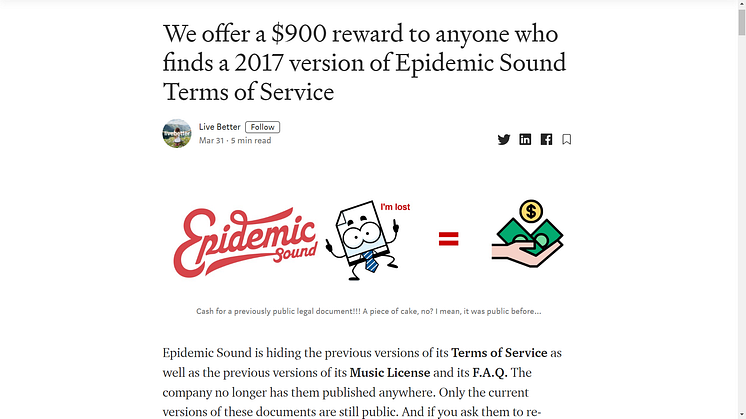
  • YouTube channel owner offers reward for lost Terms of Service

    Live Better Music claims Epidemic Sound walked back on their music licensing agreement by making content claims on Live Better’s videos on YouTube. Live Better says it licensed the tracks from Epidemic Sound legally. Problem is, they can't find the previous Terms of Service document, which proves it.

  • The cat-and-mouse game between politicians and musicians

    Politicians are playing songs at their rallies, sometimes without permission, and the musicians are getting fed up with it.
    This tends to happen to conservative politicians, who are not aligned with popular musicians who are frequently left-leaning.
    Donald Trump, a divisive politician whose rallies have featured songs by Neil Young, Rihanna and Pharrell Williams, has received letters from th

Show more